

A significant proportion of industrial component failures originate not from bulk material weakness but from tribological and chemical degradation at the surface. Friction-induced wear, corrosion, thermal cycling fatigue, and chemical exposure are the primary mechanisms by which components fail before reaching their designed service life. In sectors where materials operate at the limits of their performance envelope, including defense, aerospace, automotive, and heavy industrial manufacturing, surface engineering is an integral part of product design rather than a secondary consideration.
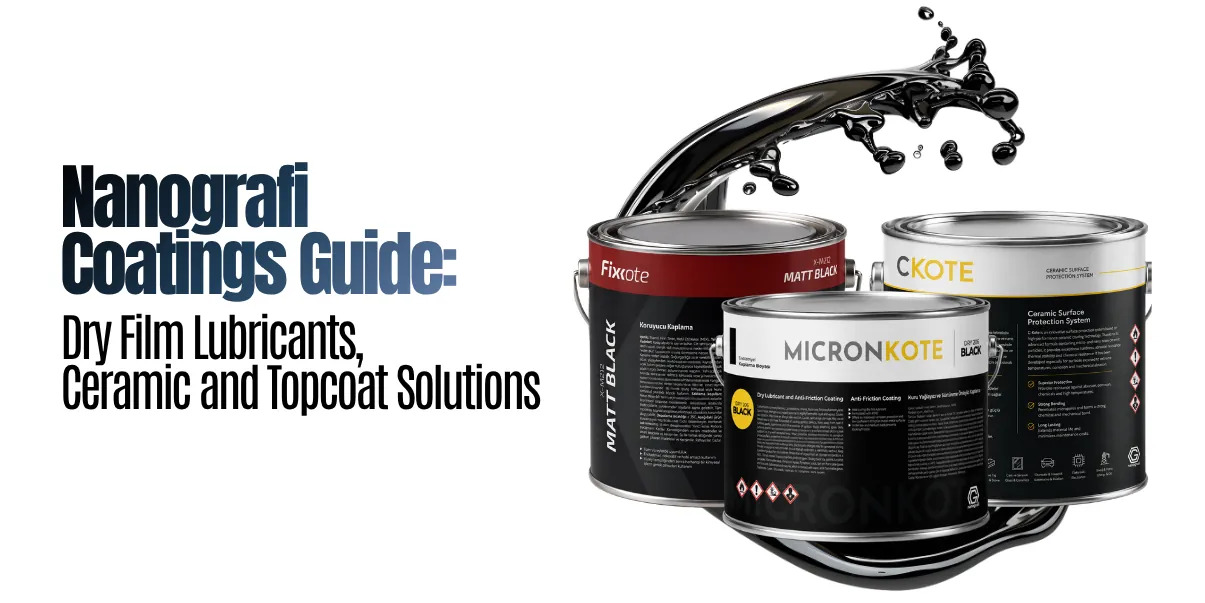
Nanografi Chemicals has developed a nanotechnology-based coatings portfolio to address this requirement. The Coatings product line spans three complementary functional categories: dry film lubricants for friction reduction, ceramic coatings for surface protection against thermal and chemical attack, and topcoat systems that combine aesthetic finish with long-term durability. The formulation structure and application parameters of each product group are outlined below.
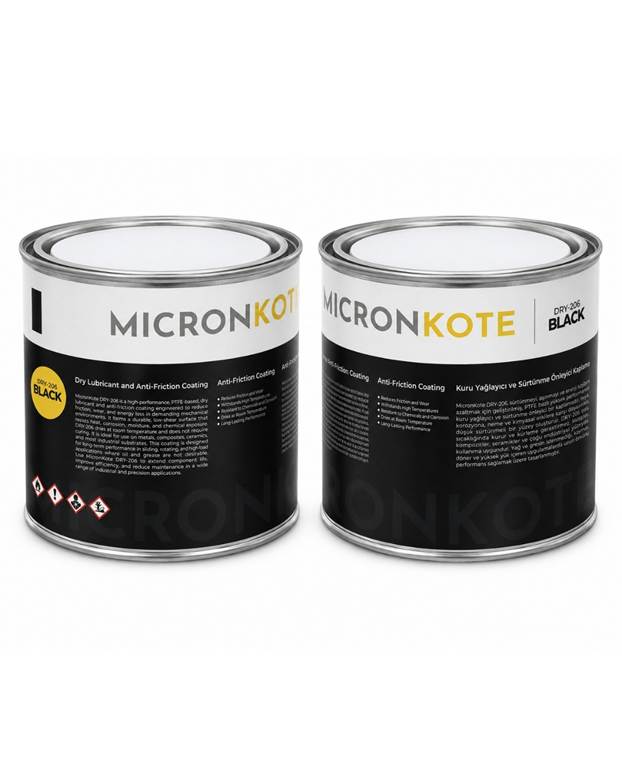
Dry Film Lubricants: Micronkote
Conventional oil- and grease-based lubricants are subject to well-documented limitations: particulate accumulation, evaporation, oxidation, and the need for periodic reapplication. These constraints are particularly disadvantageous in applications with limited maintenance access or where contamination is unacceptable. The Micronkote product line addresses these limitations by replacing liquid lubrication with a thin, chemically bonded solid film.
The product range is formulated with different solid lubricant chemistries depending on the target load, operating conditions, and application method. The PTFE- and graphite-based Dry 206 grade, containing zinc phosphate and silicone additives, is carried in a multi-component solvent system comprising MEK, MIBK, iso-butanol, cyclohexanone, and butyl glycol, featuring a density of 0.9 g/ml. It is a heat-cured system requiring 235°C for 45 minutes following a 15-minute ambient flash-off period, providing low friction, high wear resistance, and high corrosion protection for medium-to-high load metal-to-metal contacts across an operating range of -60°C to +250°C. The MoS₂-based Dry 207 grade is formulated with MoS₂ solid lubricants, organic binders, and solvents, requiring the same thermal curing process of 235°C for 45 minutes to cure to a gray film finish engineered for medium-to-heavy load applications and high contact pressures from -60°C to +250°C. For applications where oven curing is not feasible, the air
Once cured, these films provide a low and stable coefficient of friction without requiring a liquid carrier. Lacking free liquid components, Micronkote is well suited to precision assemblies, firearm components, and environments sensitive to contamination. In corrosion evaluation tests per ASTM B117 and ASTM D1654, heat-cured grades such as Dry 206 demonstrated high resistance by limiting creepage around scribed areas to an average of 0.2 mm after 48 hours of salt spray exposure, achieving a Rating No. 9 rating—a reliable performance benchmark for components operating in demanding environments.
Principal application areas for Micronkote include:
- Defense and weapons systems: bolts, gun barrels, hinges, and bearing surfaces requiring reliable movement under load without lubricant migration
- Aerospace: fasteners, bearings, and gear assemblies where weight, cleanliness, and thermal tolerance are critical requirements
- Automotive: pistons, camshafts, and brake components where friction reduction extends service life
- Industrial production: conveyor rollers, dies, and molds subject to continuous wear cycles
Ceramic Coatings: C-Kote
C-Kote serves a distinct function relative to lubricant systems: protecting the surface itself against abrasion, high temperature, and chemical attack.
C-Kote is a two-component, heat-cured ceramic coating technology formulated with micro- and nano-scale ceramic fillers, ceramic-based pigment additives, and an ambient-curable refractory resin, with chromium(III) oxide contributing to the ceramic network. During application, the coating penetrates the substrate’s microporous structure to form a chemical bond, and develops a dense ceramic network as it cures. This structure is responsible for the coating’s characteristic performance properties: a pencil hardness rating of approximately 9H, thermal stability up to approximately 1000°C, and high resistance to acids, bases, solvents, and salt water.
These properties allow C-Kote to retain color and surface integrity under conditions that would degrade conventional paint systems, a performance factor that is significant both for firearms and defense equipment (where simultaneous preservation of appearance and function is required) and for engine and exhaust components subject to repeated thermal cycling. Because the coating also limits oxidation and corrosion at the metal interface, it extends component life in industrial and marine applications where corrosion is the primary failure mechanism. As with any ceramic-filled, solvent-carried system, achieving rated hardness and adhesion values depends on correct surface preparation and adherence to the specified cure procedure.
Typical C-Kote applications include:
- Firearms and defense components requiring both durability and finish consistency
- Machine parts subject to friction, wear, and corrosion
- Exhaust systems and engine components exposed to high temperatures
- Concrete, glass, and composite surfaces requiring chemical and abrasion resistance
Topcoat System: Fixkote
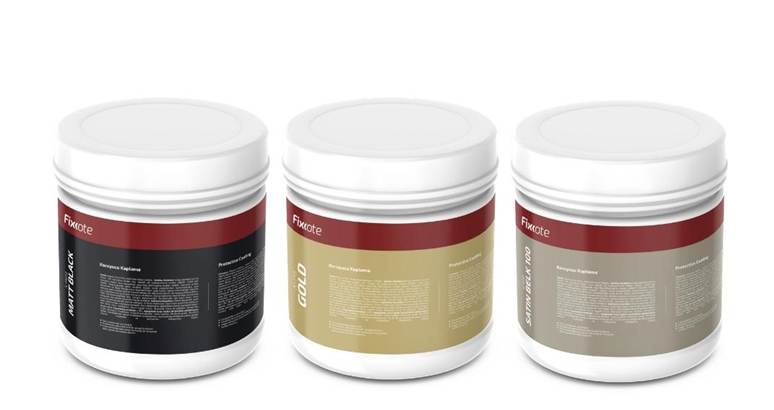
Fixkote is a two-component topcoat developed to combine aesthetic finish with long-term durability. It imparts an anodized-like texture to the treated surface while providing resistance to water, chemicals, abrasion, and thermal expansion.
The system is, technically, a two-component (2K) polyurethane-type coating. The base component is reduced using a thinner formulated for primers and varnishes (a toluene/acetone/glycol ether blend), while the hardener component is isocyanate-based, formulated in xylene and a glycol ether ester. This isocyanate-polyurethane reaction produces the cross-linked, chemical- and abrasion-resistant film characteristic of cured Fixkote, and is comparable in principle to the polyurethane topcoat technology used in industrial and aerospace coating systems. It provides strong adhesion across a broad range of substrates, including aluminum (the most compatible substrate), steel, plastic, glass, copper, and brass. Typical film thickness ranges from 5 to 15 microns; the coating is spray-applied and cured at 50 to 70°C, with a tack-free time of approximately 30 minutes and full cure within 20 to 25 minutes at temperature (24 to 48 hours for full ambient cure). The finish is available in several color and texture options, including matte black, matte chrome, and satin variants. As with other two-component isocyanate systems, adherence to the specified base-to-hardener mixing ratio and adequate ventilation during application and cure are standard requirements for the coating to reach its full mechanical and chemical resistance.
Owing to its resistance to UV exposure, temperature fluctuation, and sustained chemical contact, Fixkote is used in:
- Defense: weapon components and ground defense system housings
- Decorative and touch-up applications: restoring an anodized appearance without full anodizing infrastructure
- General metal components: applications requiring corrosion resistance and surface hardness combined with a clean finish
Integrated Coating System Approach
The three product lines are not mutually exclusive; in practice, they are frequently applied in combination. In a firearm assembly, for example, Micronkote may be applied to load-bearing pins and bolts to maintain friction-free movement, C-Kote to the housing for thermal and abrasion resistance, and Fixkote as a final protective and decorative topcoat. The same principle applies across aerospace, automotive, and industrial equipment: coating selection should be based on the failure mechanism to be prevented rather than the surface alone.
Nanografi’s broader coatings and chemical solutions portfolio extends beyond these three products, including NIR camouflage coatings for defense optical signature management and specialized surface modifiers for additional industrial applications, all developed under the same nanotechnology-driven R&D framework.
About Nanografi Chemicals
Nanografi Chemicals develops its coating technologies in-house, supported by the company’s broader materials science and nanotechnology R&D infrastructure based at METU Technopolis, Ankara. This structure allows formulations, from solvent carrier selection to cure schedule and hardener chemistry, to be adapted to specific load, temperature, and chemical exposure requirements rather than applying a generic product to a specialized use case. This distinction is particularly significant in defense and military applications, where component failure represents an operational risk rather than a cost consideration alone.
For technical documentation, including safety data sheets, and application guidance specific to your substrate and operating conditions, contact the Nanografi Chemicals team.