

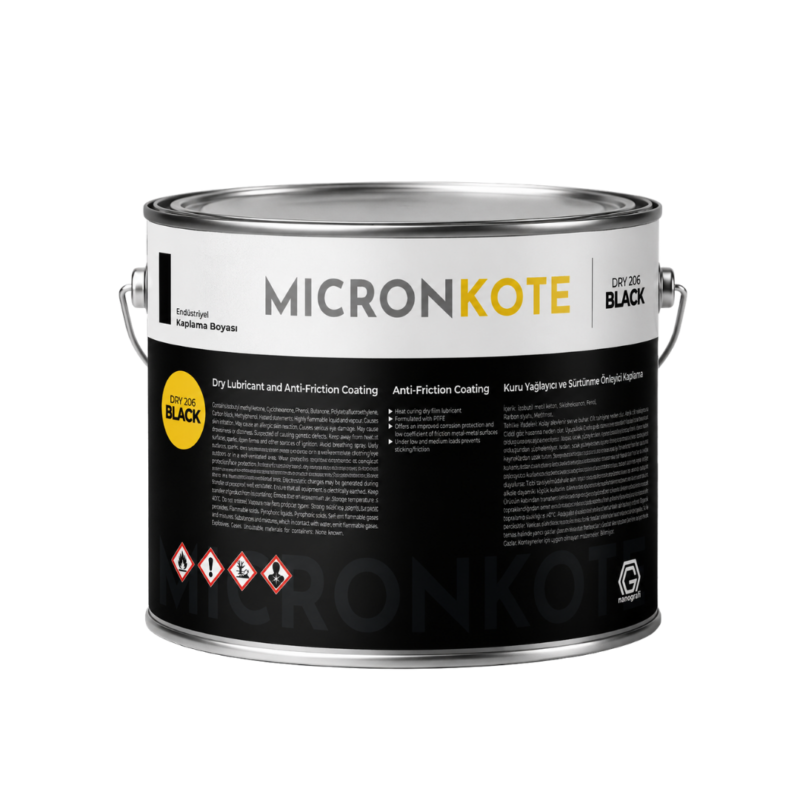
Micronkote 206
Micronkote 206 is a solvent-based, PTFE solid film lubricant coating. It cures at 235 °C for 45 minutes into a bonded black film of 5-22 µm that lubricates metal-to-metal contact surfaces running at slow to moderate sliding speeds under medium to high loads.
Zinc phosphate in the formulation adds corrosion resistance. The cured film resists oils, greases and solvents, holds its lubricating function from -60 °C to +250 °C, and helps prevent fretting corrosion and seizure under sustained mechanical loading.
Key technical specifications
- Product type
- Solvent-based solid film (dry film) lubricant coating, PTFE-based
- Suitable surfaces
- Metal-to-metal contact surfaces
- Colour
- Black
- Density
- 0.9 ± 0.1 g/cm³
- Dry film thickness
- 5-22 µm
- Curing conditions
- 235 °C / 45 min
- Functional lubrication temperature range
- -60 °C to +250 °C
- Application method
- Spray gun, brush, roller or dipping
- Coefficient of friction
- 0.05-0.07LFW-1, rotating, 2,860 N
- Load-carrying capacity
- 19,000-20,000 NASTM D2625, Procedure B
What is Micronkote 206?
Micronkote 206 is a black, solvent-based solid film lubricant coating built on PTFE. It is supplied as a liquid, applied by spray, brush, roller or dipping, and cured at 235 °C for 45 minutes to leave a bonded dry film 5-22 µm thick.
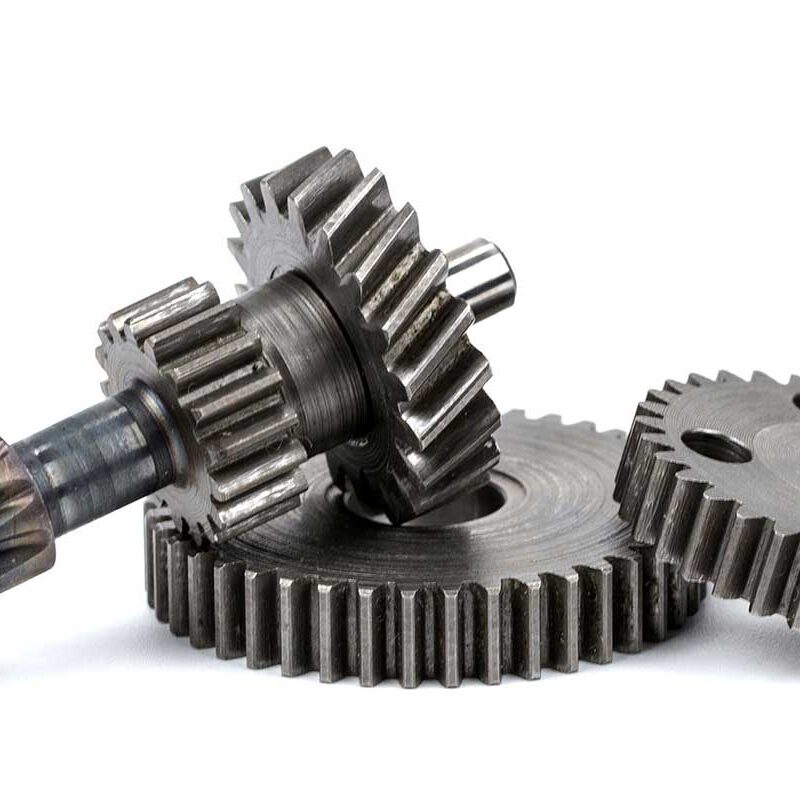
It is used where two metal surfaces slide against each other under load and a fluid lubricant is impractical or cannot be maintained. Micronkote 206 is part of the Micronkote dry film lubricant range.
What it is
A PTFE-based solid film lubricant coating, supplied as a solvent-borne liquid and heat-cured into a bonded dry film of 5-22 µm.
What it solves
Friction and wear on loaded metal contacts, and the fretting corrosion and seizure that follow sustained mechanical loading.
Where it is used
Metal-to-metal contact surfaces running at slow to moderate sliding speeds under medium to high loads.
Why a dry film
The lubricant is bonded to the surface instead of held as a fluid film, and stays functional from -60 °C to +250 °C, where maintaining an oil or grease film is impractical.
How Dry Film Lubrication Works
PTFE and corrosion-inhibiting solids are carried in a resin binder. Once cured, the binder anchors them to the prepared substrate as a continuous 5-22 µm film.
Under load the PTFE film shears in preference to the metal surfaces beneath it, giving a coefficient of friction of 0.05-0.07 under a 2,860 N rotating load.
Zinc phosphate in the formulation adds corrosion resistance, so the same layer that lubricates also protects the contact face.
Technical Performance
| Property | Test condition | Result | Standard |
|---|---|---|---|
| As supplied | |||
| Viscosity | Ford Cup No. 4 flow time, 25 ± 2 °C | 20 ± 5 s | Internal test |
| Density | - | 0.9 ± 0.1 g/cm³ | Internal test |
| Curing temperature | 235 °C | 45 min | Internal test |
| As cured | |||
| Endurance life | 4,450 N | 450-500 min | ASTM D2625 |
| Endurance life | 4,450 N | 490 min | ASTM D2625, Procedure A |
| Load-carrying capacity | - | 19,000-20,000 N | ASTM D2625, Procedure B |
| Coefficient of friction | LFW-1, rotating, 2,860 N load | 0.05-0.07 | ASTM D2714 |
| Coefficient of friction | LFW-1, oscillating, 900 N load | 0.03-0.05 | ASTM D2714 |
| Colour | - | Black | ASTM D2244 |
| L* | - | 25.00 to 35.00 | ASTM D2244 |
| a* | - | -0.10 to -0.02 | ASTM D2244 |
| b* | - | -1.10 to -1.01 | ASTM D2244 |
| Functional lubrication temperature range | - | -60 °C to +250 °C | Internal test |
Features and Benefits
- Low coefficient of friction
- 0.05 to 0.07 under a 2,860 N rotating load and 0.03 to 0.05 under a 900 N oscillating load (ASTM D2714).
- Medium to high load-carrying capacity
- 19,000 to 20,000 N load-carrying capacity, with 450 to 500 minutes endurance life at 4,450 N (ASTM D2625).
- Wide functional temperature range
- Lubricates from -60 °C to +250 °C.
- Corrosion resistance
- Zinc phosphate in the formulation gives the cured film enhanced corrosion resistance; humidity resistance verified to EN ISO 6270-1.
- Resistant to oils, greases and solvents
- Fluid resistance verified to ASTM D2510 Proc. A / MIL-PRF-46010G.
- Thin, strongly bonded film
- Passes adhesion and cross-cut testing (ASTM D3359) at a dry film thickness of 5-22 µm.
Applications
Formulated for metal-to-metal contacts operating at slow to moderate sliding speeds under medium to high mechanical loads.
The cured film helps prevent fretting corrosion and seizure on components held under sustained mechanical loading.
The cured film is resistant to oils, greases and solvents, with fluid resistance verified to ASTM D2510 Proc. A / MIL-PRF-46010G.
The coating retains its lubricating function across a functional lubrication temperature range of -60 °C to +250 °C, and passes thermal stability testing to IEC 60068-2-12.
Zinc phosphate in the formulation adds corrosion resistance, confirmed by humidity resistance testing to EN ISO 6270-1.
Surface Preparation and Application
Surface Preparation
Product Preparation and Application
Curing
Curing Conditions
Cure the applied film for 45 minutes at 235 °C. Surfaces must be clean, dry and free from oil before application, and sandblasting or phosphating improves adhesion and coating life.
Technical Test Results
| Test | Result | Standard |
|---|---|---|
| Thermal stability | Pass, no deformation | IEC 60068-2-12 |
| Adhesion test | Pass, no deformation | ASTM D2510 Proc. A / MIL-PRF-46010G |
| Resistance to humidity | Pass, no deformation | EN ISO 6270-1 |
| Resistance to fluids | Pass, no deformation | ASTM D2510 Proc. A / MIL-PRF-46010G |
| Cross-cut test | Pass, no deformation | ASTM D3359 |
Values are taken from the current Micronkote 206 test and specification data. Properties that are not stated in the source documents are not published here.
Storage, Handling and Packaging
Storage temperature: +5 °C to +30 °C. Store the product in its original, tightly sealed packaging in a dry, well ventilated, fire-resistant area, away from direct sunlight, heat, sparks and open flames. Protect it from freezing and from extreme temperatures. After prolonged storage, mix the product thoroughly until homogeneous before use.
Shelf life: 12 months from the date of production.
Packaging: supplied in sealed containers; the net fill is stated on the product label. Contact us for currently available pack sizes.
Safety: Micronkote 206 is a solvent-based product classified under CLP Regulation (EC) No 1272/2008 with the signal word Danger. It is a highly flammable liquid and vapour and carries health and aquatic hazard classifications. Read the Safety Data Sheet in full and follow the precautions on the product label before handling. Transport classification: UN 1224, Class 3, Packing Group II.
Frequently Asked Questions
Micronkote 206 is a black, solvent-based PTFE solid film lubricant coating. It is applied as a liquid and cured into a bonded dry film of 5-22 µm for metal-to-metal contact surfaces.
Yes. Micronkote 206 is a dry film (solid film) lubricant coating. The lubricant is bonded to the surface as a solid layer rather than applied as an oil or grease.
It is used on metal-to-metal contact surfaces running at slow to moderate sliding speeds under medium to high loads, to reduce friction and wear and to help prevent fretting corrosion and seizure.
Micronkote 206 is cured at 235 °C for 45 minutes.
The cured dry film thickness is 5 to 22 µm.
-60 °C to +250 °C.
0.05 to 0.07 measured on an LFW-1 machine under a 2,860 N rotating load, and 0.03 to 0.05 under a 900 N oscillating load (ASTM D2714).
Load-carrying capacity is 19,000 to 20,000 N to ASTM D2625 Procedure B. Endurance life is 450 to 500 minutes at 4,450 N.
By pressure spray gun, brush, roller or dipping, onto a cleaned, oil-free and sandblasted or phosphated surface, then cured at 235 °C for 45 minutes.
In its original, tightly sealed packaging at +5 °C to +30 °C, in a dry, well ventilated, fire-resistant area away from sunlight, heat, sparks and open flames. Shelf life is 12 months from the date of production.
The Safety Data Sheet is linked at the top of this page under Safety Data Sheet (SDS). Use the Download SDS button.